Access to EMTP user presentations, webinars, and slide deck presentations.
69 presentations for Simulation:
Author(s): Bjorn Gustavsen, SINTEF Energy Research
Type:Technical Presentation
Date: 2020-11-20
Abstract
<h2 class="title">EMTP Europe User Conference 2019 </h2> <p class="tagline"><b>The EMTP User Conference pres... see moreentations are now available online!</b></p> <p id="text-intro"><b>Inclusion of a White-Box Transformer Model in EMTP</b><br> Transformer manufacturers make use of detailed (white-box) transformer models for calculating internal voltages during the lightning impulse test. Such white-box models could also be utilized in general transient simulation studies. This presentation describes the inclusion of one white-box model in EMTP using DLL code. The resulting model is highly efficient and it can be used to study internal overvoltages in the transformer during network transients, e.g. swithing operations and lightning strokes. The visualization of internal voltages is achieved by a matlab-based tool.
Author(s): Paul Poujade, EDF
Type:Technical Presentation
Date: 2020-11-20
Abstract
<h2 class="title">EMTP Europe User Conference 2019 </h2> <p class="tagline"><b>The EMTP User Conference pres... see moreentations are now available online!</b></p> <p id="text-intro"><b>EMTP Simulation of Micro-Grids: from 100% Conventional Synchronous Generation to 100% Inverter-based Generation</b><br>
Author(s): Manuel Martinez & Paul Poujade, EDF
Type:Technical Presentation
Date: 2020-11-20
Abstract
<h2 class="title">EMTP Europe User Conference 2019 </h2> <p class="tagline"><b>The EMTP User Conference pres... see moreentations are now available online!</b></p> <p id="text-intro"><b>Transformer Energization Study Case with PAMSUITE</b><br> A number of EMTP studies require parametric simulations. It is namely the case for transformer energization where many uncertain parameters can greatly influence the simulation results. This presentation will show how these kinds of studies can be quickly and easily carry out with PAMSUITE, the EMTP toolbox for parametric studies.
Author(s): Ilhan Kocar, Polytechnique Montréal
Type:Technical Presentation
Date: 2020-11-20
Abstract
<h6 class="text-black" style="padding-bottom: 30px; padding-top: 30px; text-align: justify;">Speaker: <strong>Ilhan Kocar</strong... see more>, <em>Polytechnique Montréal</em></h6> <p class="text-black">The new WB model encapsulates many improvements including state-of-the-art research results. It eliminates the modeling problems encountered with the existing universal line model (ULM) approach.<br> In the new model, there is no limitation on the number of conductors. For symmetric coaxial cable systems with several cables, numerical problems are avoided by using the new cable correction function. The newly added DC correction scheme together with frequency band partitioning ensures high precision both at low frequencies and high frequencies. Frequency partitioning also improves the numerical conditioning of the system of equations. Unrealistic delays are avoided thanks to the new routines for the identification and adjustment of time delays. The delay adjustment is a search routine with boundaries for optimized fitting.<br><br> The state space formulation in time domain is reformulated using a precise discrete integration method. It minimizes the numerical integration and interpolation errors. This allows achieving stable simulations with larger time steps. The object oriented programming approach with vectorized variables and new memory allocation routines significantly improves the simulation speed and use of memory. The new initialization routines allow seamless transition from steady state solution into time domain simulations.</p></div>
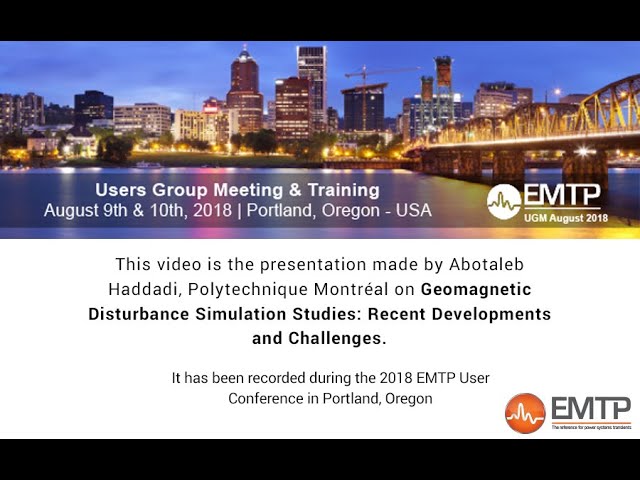
Author(s): Aboutaleb Haddadi, Polytechnique Montréal & Afshin Rezaei-Zarei, York University
Type:Technical Presentation
Date: 2020-11-20
Abstract
<h6 class="text-black" style="padding-bottom: 30px; padding-top: 30px; text-align: justify;">Speaker: <strong>Aboutaleb Haddadi</... see morestrong>, <em>Polytechnique Montréal</em></h6> <p class="text-black">Inverter-based resources have much more complex fault current characteristics compared to conventional synchronous generators. Hence, legacy protective relays set under the assumption of a conventional power system with predominantly synchronous generation, may misoperate under high level of renewables.<br><br> This presentation first investigates the impact of wind generation on the performance of negative-sequence-based protection. In many applications, wind generators are designed to suppress negative sequence current partially or entirely. Negative sequence current suppression control may result in the misoperation of protection schemes whose operation relies on the assumption of negative sequence quantities being present in substantial levels during unbalanced faulted conditions. The impact of wind generation on negative-sequence overcurrent and negative-sequence-based directional elements is investigated in this work.<br> In addition, the impact of renewable resources on the performance of power swing protection is investigated. Case studies with examples of Power Swing Blocking (PSB) and Out-of-Step Tripping (OST) elements misoperation under wind generation will be presented.</p>
![[R&D]_EMTP : Recherche et développement](https://www.emtp.com/system/files/imagecache/presentation/slide1_1.jpg "[R&D]_EMTP : Recherche et développement")
![[Protection_Devices]_Étude des courants coupés par les sectionneurs de changemen](https://www.emtp.com/system/files/imagecache/presentation/TechnicalPresentation1.jpg "[Protection_Devices]_Étude des courants coupés par les sectionneurs de changemen")