Access to EMTP user presentations, webinars, and slide deck presentations.
23 presentations for hvdc:
Author(s): Stefan Kovacevic, Dragan Jovcic, Pierre Rault, Olivier Despouys
Type:Technical Presentation
Date: 2021-03-05
Abstract
It is well-known that an LCC HVDC may deteriorate damping of torsional modes of nearby turbine-generators, and for weak AC grid connections the HVDC may even destabilize the system. There are fewer dy... see morenamic studies with MMC although recent literature indicates that an MMC HVDC connected in close proximity of an LCC HVDC may generally improve stability. However, these studies do not consider the generator-HVDC torsional interactions in the subsynchronous domain (SSTI).
This article investigates the risk of the SSTI in a dual-infeed HVDC system (LCC and MMC) and in comparison to a single HVDC system. The test topology is inspired by the North French system in which a 2 GW LCC HVDC cross-channel link IFA2000 (1986) is connecting the French and the English AC grid. The HVDC is coupled on the French side with a 1.12 GW nuclear generator in the Gravelines plant and experimental studies showed that there may be a substantial risk of SSTI, particularly with respect to the dominant 6.3 Hz torsional mode.
This system is now becoming a hybrid dual-infeed HVDC since a 1 GW MMC HVDC Eleclink is being installed in proximity of the existing LCC HVDC, on the French side. This raises concerns of new SSTI stability issues.
Author(s): Anton Stepanov
Type:Technical Presentation
Date: 2020-12-11
Abstract
<p>Sub-synchronous oscillations are an undesirable phenomenon in power systems. It is associated with the energy exchange between different elements of the system. Power electronics-base... see mored devices, such as windfarms and AC/DC converters are also prone to such oscillations. In this presentation, a case of sub-synchronous oscillations between type 3 wind turbines and MMC-based HVDC transmission is demonstrated and analyzed using EMTP.</p><p>
Overview: - Introduction - System overview - SSO demonstration - Analysis – Conclusions</p>
Author(s): Anton Stepanov, Polytechnique Montréal
Type:Technical Presentation
Date: 2020-11-20
Abstract
<h2 class="title">EMTP USA User Conference 2019 </h2> <p class="tagline"><b>Sub-synchronous oscillations wit... see moreh type 3 wind turbines and MMC-HVDC</b></p> <p id="text-intro">Sub-synchronous oscillations is an undesirable phenomenon in power systems. It is associated with the energy exchange between different elements of the system. Power electronics-based devices, such as windfarms and AC/DC converters are also prone to such oscillations. In this presentation, a case of sub-synchronous oscillations between type 3 wind turbines and MMC-based HVDC transmission is demonstrated and analyzed using EMTP.
Author(s): Pierre Rault, RTE
Type:Technical Presentation
Date: 2020-11-20
Abstract
<h2 class="title">EMTP Europe User Conference 2019 </h2> <p class="tagline"><b>The EMTP User Conference pres... see moreentations are now available online!</b></p> <p id="text-intro"><b>Influence of HVDC Controls on Transient Stability of Synchronous Machines</b><br> With the energy transition in France and in Europe, the transmission grid is strongly impacted by the forthcoming connection of power electronics devices, such as offshore wind farms and HVDC interconnections. These new devices use power electronics converters that generate transients which are usually more complex to analyzed than for standard AC devices, in particular during faults. These phenomena can have an impact on the grid stability.<br> The presentation will focus on the transient stability studies of synchronous generator influenced by power electronics devices. The objective is to compare the critical fault clearing time for different fault locations, fault conditions and different HVDC converter fault ride through control strategies. Generic test cases as well as real scenarios are considered. In this study, the critical time is obtained with bisection method thanks to the new parameter sweep toolbox.
Author(s): Sébastien DENNETIERE, RTE – Centre National d’Expertise Réseaux
Type:Technical Presentation
Date: 2020-11-20
Abstract
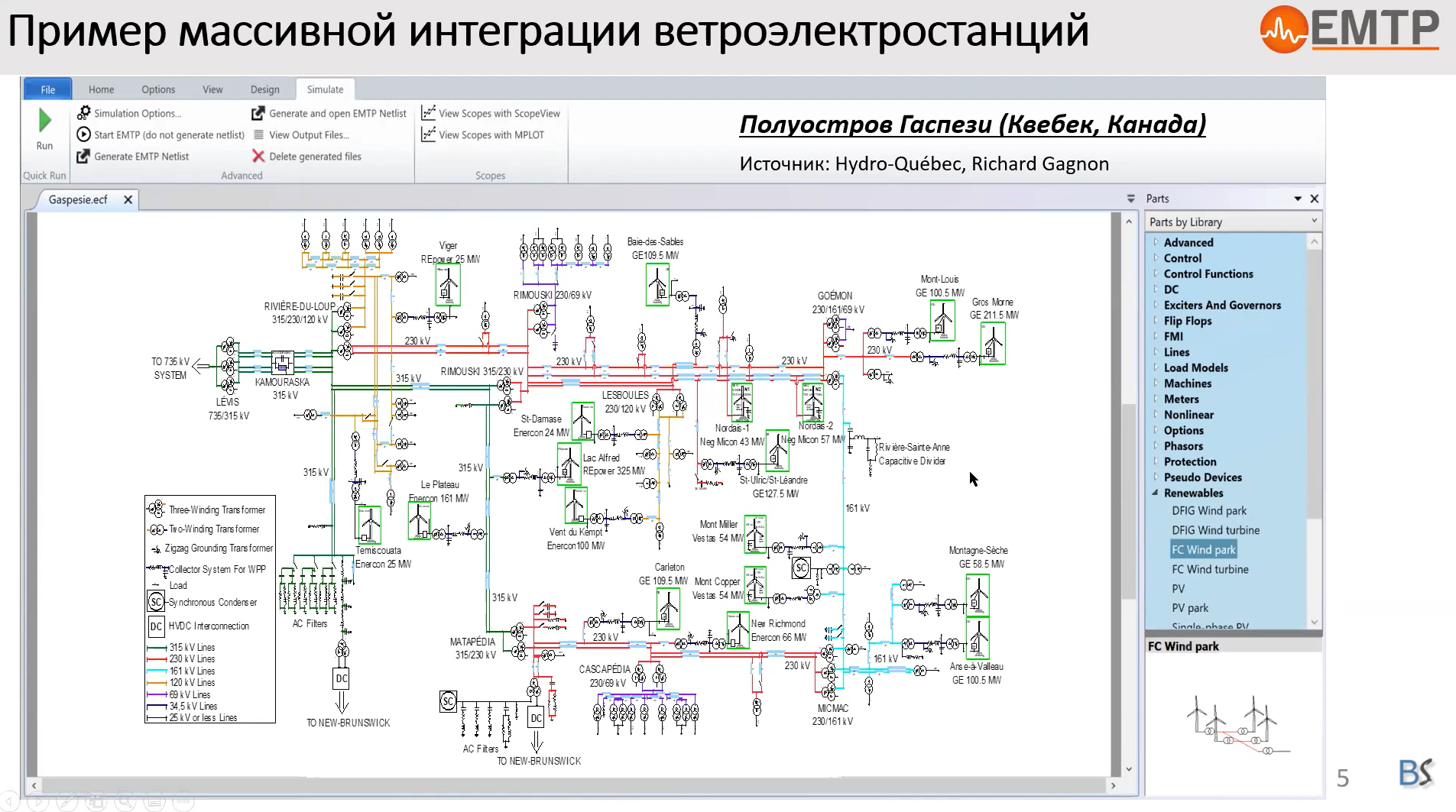
<h6 class="text-black" style="padding-bottom: 30px; padding-top: 30px; text-align: justify;">Speaker: <strong>Sébastien DENNETIERE&... see morelt;/strong>, <em>RTE – Centre National d’Expertise Réseaux</em></h6> <p class="text-black">A high voltage direct current (HVDC) grid is a power transmission system which consists of multiple HVDC terminals interconnected through DC lines. The advantages of a DC grid are increasing system flexibility and reliability and providing redundancy at a lower cost by sharing resources, resulting in lower power losses. In order to test and compare technical solutions that can be applied on a realistic DC grid, CIGRE B4 Study committee decided to propose a VSC based DC Grid test system with ac and dc parts with all input data suitable for EMT simulation. This first benchmark has been developed in 2014 in EMTP and different simulation tools in order to validate the completeness of data provided in the Technical Brochure #604. The test system has 11 AC/DC VSC converters, 2 DC/DC converters and 2 DC voltage levels (±400kV and ±200kV).<br><br> The main purpose of the test system is to provide a common basis for all CIGRE SC B4 WGs that work on the research of DC grids. This benchmark model generated a high interest. Some limitations on this benchmark (topology, equipment included…) have been identified so far. In order to provide common study platforms to meet the most different HVDC grid study purposes and needs, seven HVDC grid test models have been established by the B4-72 CIGRE WG. These models have been designed to cover most HVDC grid applications including collection, integration and transmissions of onshore/offshore renewable power generation over long distance, LCC-HVDC grids, LCC-VSC hybrid HVDC grids, AC system interconnections for different types of studies with appropriate and applicable sizes. The presentation will address the issues related to the modeling of the largest DC grid test system proposed by this WG. This grid model includes 22 VSC converter stations, 4 LCC converter stations, PV and wind generations. </p>
![[R&D]_EMTP : Recherche et développement](https://www.emtp.com/system/files/imagecache/presentation/slide1_1.jpg "[R&D]_EMTP : Recherche et développement")
![[Protection_Devices]_Étude des courants coupés par les sectionneurs de changemen](https://www.emtp.com/system/files/imagecache/presentation/TechnicalPresentation1.jpg "[Protection_Devices]_Étude des courants coupés par les sectionneurs de changemen")